The UK Redundancy Process: A Step-by-Step Guide for Employers
A clear, step-by-step walkthrough of the UK redundancy process for small employers — covering business case, pools and selection, individual consultation, notice periods, statutory pay and final paperwork.
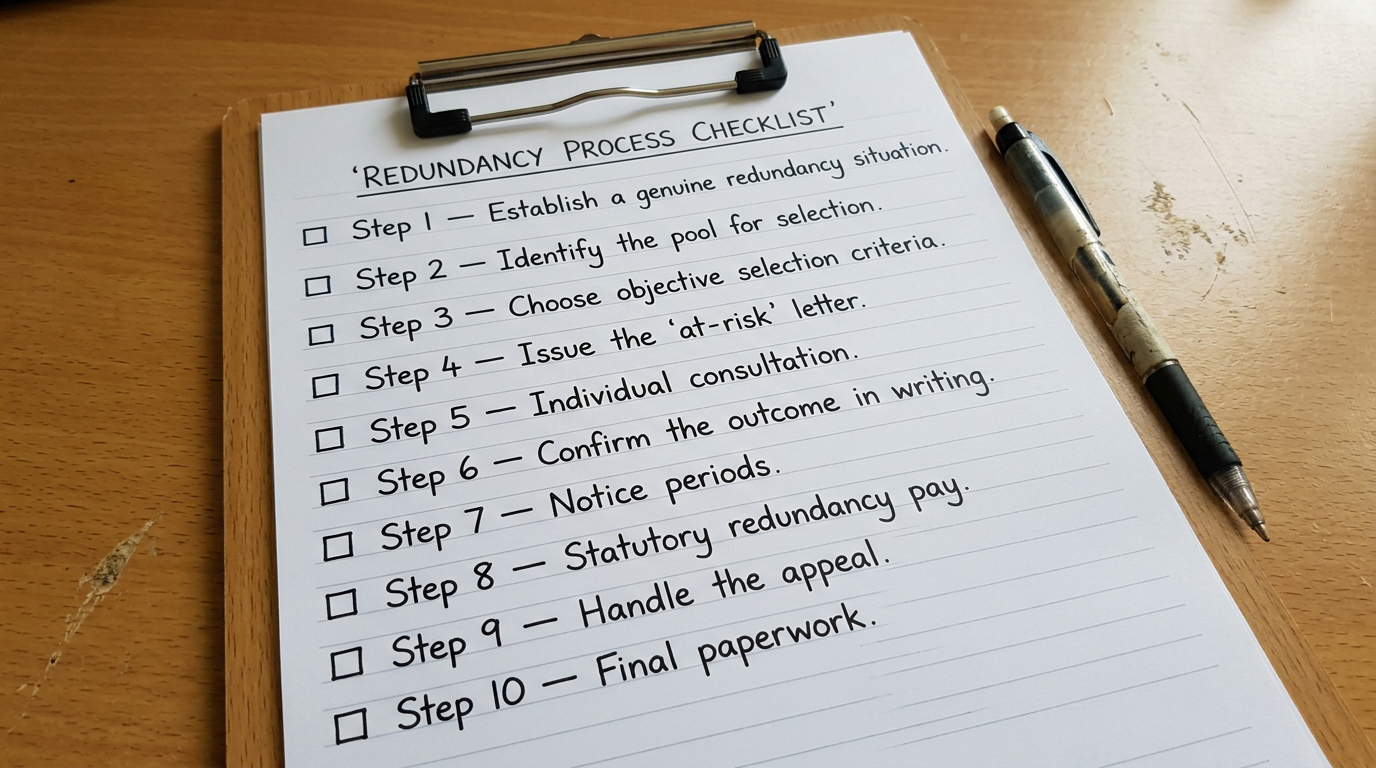
Making someone redundant is one of the hardest things a small employer ever has to do. It is also one of the easiest processes to get legally wrong. UK redundancy law is unforgiving on procedure: even when the business reason is genuine, missing a consultation step or applying selection criteria badly can turn the dismissal into an unfair one — with awards typically running £8,000–£14,000 per employee, plus legal costs.
This guide walks through the UK redundancy process end-to-end for employers making fewer than 20 roles redundant in one establishment (individual redundancy). If you are proposing 20 or more, collective consultation rules apply and the timeline is very different — see the note at the end.
Step 1 — Establish a genuine redundancy situation
Under section 139 of the Employment Rights Act 1996, a redundancy only exists where:
the business is closing, or
a workplace is closing, or
the need for employees to do work of a particular kind has ceased or diminished.
Before you do anything else, write down the business case in plain language: what has changed, what the financial or operational impact is, and why a role (not a person) is no longer needed. This document is the foundation of every conversation, letter and tribunal defence that follows.
Step 2 — Identify the pool for selection
If only one person does a unique role, the pool is one and selection is straightforward. Where two or more employees do similar work, you must define a "pool" of at-risk roles and apply objective selection criteria across it. Getting the pool wrong is the most common reason small-employer redundancies fail at tribunal.
A defensible pool reflects who actually does interchangeable work — not who you would prefer to keep. Document why each role is in or out of the pool.
Step 3 — Choose objective selection criteria
Selection criteria must be measurable, applied consistently, and free from discrimination. Common defensible criteria include:
Skills, qualifications and experience relevant to the future role mix.
Standard of work or performance, evidenced by appraisals.
Attendance (excluding absences related to disability, pregnancy or maternity).
Disciplinary record (live warnings only).
Avoid "last in, first out" as a standalone criterion — it can indirectly discriminate by age. Score every person in the pool against the same criteria and keep the scoring sheet.
Step 4 — Issue the "at-risk" letter
Once the pool is set, write to every employee in the pool to tell them their role is at risk of redundancy. The letter should explain the business reason, the size of the pool, the selection criteria, the proposed timeline, and invite them to a first consultation meeting. This is also the point to confirm their right to be accompanied.
Step 5 — Individual consultation
Consultation must be genuine, not a rubber stamp on a decision already made. For individual redundancies there is no fixed statutory length, but a meaningful process usually involves at least two meetings with each affected employee, spaced several days apart.
In consultation you must:
Explain the business reason and answer questions.
Share the selection criteria and, where relevant, the employee's scores.
Discuss any alternatives to redundancy — reduced hours, redeployment, voluntary redundancy.
Consider any suitable alternative employment within the business (or group).
Listen to and respond to the employee's representations in writing.
Step 6 — Confirm the outcome in writing
After consultation, if redundancy is still the outcome, issue a dismissal letter that sets out:
The reason for dismissal (redundancy).
The effective date of termination.
The notice period being given (and whether worked or paid in lieu).
The statutory redundancy payment calculation and any enhanced terms.
Outstanding holiday pay and final salary arrangements.
The right of appeal and how to exercise it.
Step 7 — Notice periods
Statutory minimum notice is one week for between one month and two years' service, then one additional week per complete year of service up to a maximum of twelve weeks. The contractual notice period applies if it is longer. Notice can be worked, paid in lieu (if the contract allows), or placed on garden leave.
Step 8 — Statutory redundancy pay
Employees with at least two years' continuous service are entitled to statutory redundancy pay, calculated using age, length of service (capped at 20 years) and a weekly pay figure (capped — the cap is updated each April). The formula is:
0.5 week's pay for each full year of service under age 22.
1 week's pay for each full year of service from age 22 to 40.
1.5 weeks' pay for each full year of service from age 41 onwards.
Statutory redundancy pay up to £30,000 is tax-free. Payment must be made on or shortly after the termination date and itemised on the final payslip.
Step 9 — Handle the appeal
Give the employee a reasonable window (usually five to seven working days) to appeal the decision in writing. The appeal should be heard by someone who was not involved in the original decision wherever possible, and the outcome confirmed in writing.
Step 10 — Final paperwork
On or before the termination date, provide:
Final payslip showing salary, holiday pay and redundancy payment.
P45.
Written confirmation of the statutory redundancy calculation.
A reference policy or agreed reference text, if requested.
Protected categories — extra care
Be especially careful where employees are pregnant, on maternity or shared parental leave, have a disability, have recently raised a grievance, or are trade union representatives. They have additional legal protections — for example, employees on maternity leave have priority for suitable alternative employment under regulation 10 of the Maternity and Parental Leave Regulations. Get advice if any of these apply.
20 or more redundancies — collective consultation
If you propose to dismiss 20 or more employees at one establishment within a 90-day period, collective consultation rules under the Trade Union and Labour Relations (Consolidation) Act 1992 apply. You must:
Consult employee representatives (or a trade union).
Notify the Redundancy Payments Service using form HR1 before consultation starts.
Consult for at least 30 days (20–99 redundancies) or 45 days (100+) before any dismissal takes effect.
Penalties for getting collective consultation wrong are significant — up to 90 days' pay per affected employee as a protective award.
How Redundly helps
Redundly walks you through every step above — pool definition, selection scoring, individual consultation timeline, statutory pay calculations and the full letter set — in about 15 minutes, producing a complete, personalised redundancy pack from £199. If your situation is borderline (collective thresholds, protected categories, complex pools), the tool flags it before you commit so you can take specialist advice.
This article is process guidance, not legal advice. UK employment law changes; check current Acas guidance and the gov.uk redundancy pages before acting on a specific case.